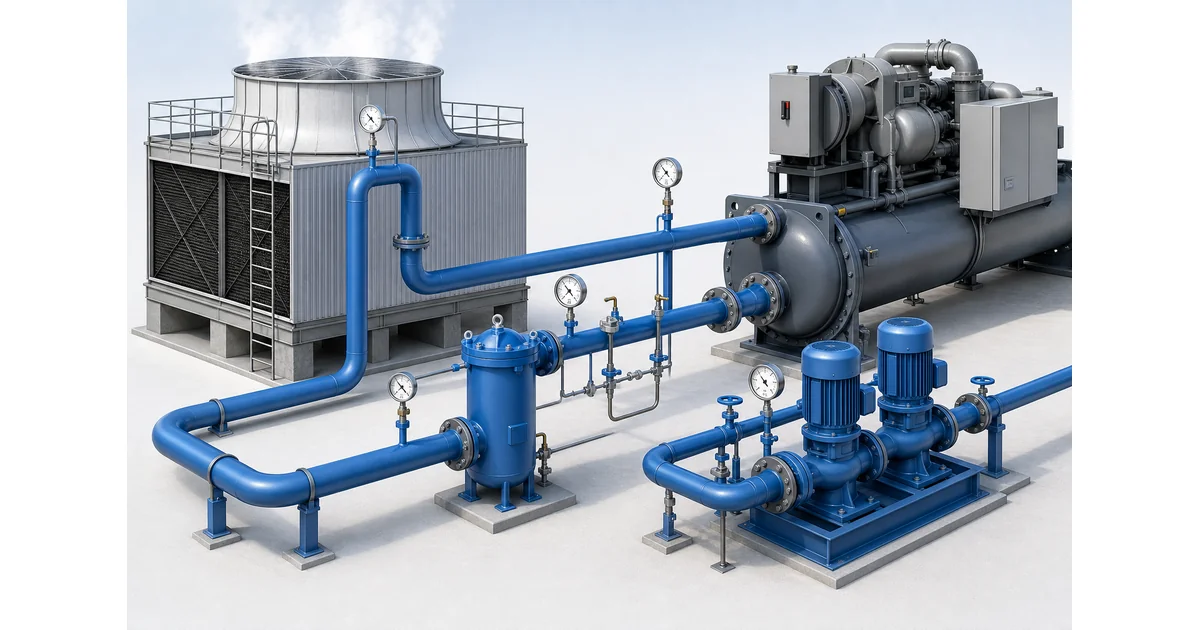
Cooling tower pressure gauge monitoring turns an open condenser-water loop from a hidden hydraulic system into a set of readable operating points. In HVAC central plants, process-cooling skids, data centers and factories, gauges around pumps, strainers, side-stream filters, heat exchangers and cooling tower risers help operators see blockage, low flow, pump issues and abnormal pressure loss before temperature alarms are the only clue.
Why cooling tower pressure gauge monitoring matters
Cooling tower pressure gauge monitoring is the practice of measuring local pressure and pressure drop in a condenser-water system that rejects heat through an evaporative cooling tower. The loop is usually open to air at the tower, so it can collect airborne debris, biological growth, corrosion products, scale and treatment chemicals. Those contaminants change hydraulic resistance before they always show up as a visible leak or failed pump.
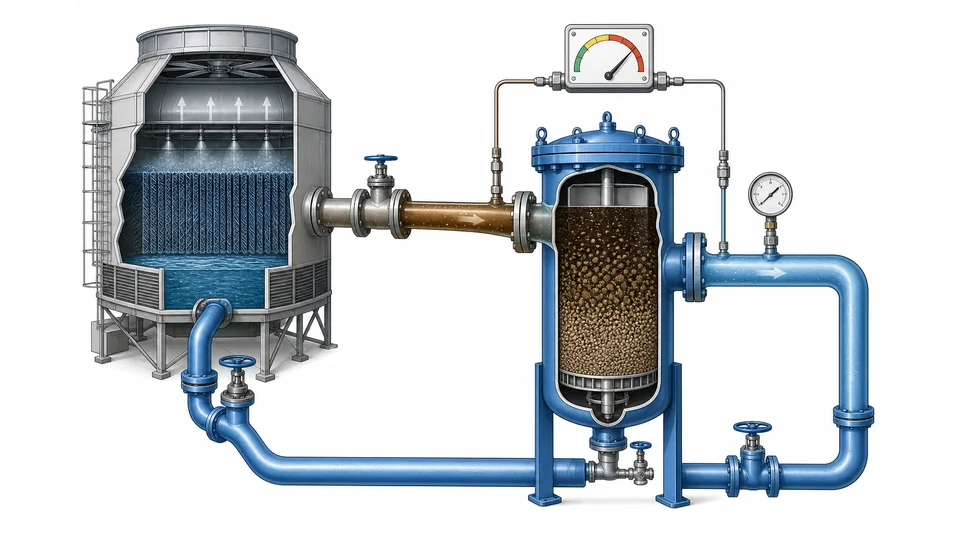
The U.S. Department of Energy guide on side-stream filtration for cooling towers describes automatic backwash filters that respond when a differential pressure threshold is exceeded. That is the core value of pressure instrumentation in these systems: it gives maintenance teams a simple operating number for fouling, blocked strainers and filter loading.
Browse Stainless Steel Pressure Gauges →Explore 143+ industrial gauge models→Gauge points for condenser-water loops
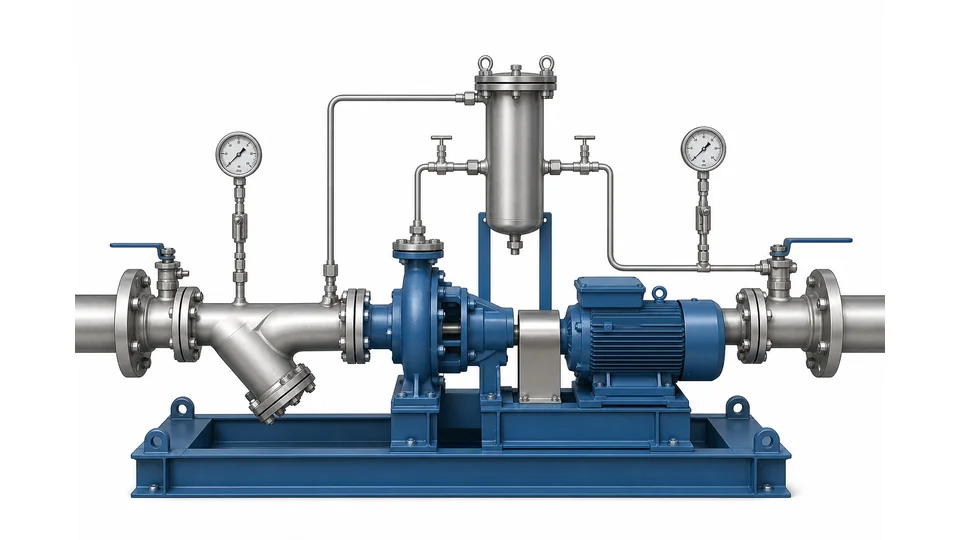
Start with a pressure-point map rather than a single gauge at the pump discharge. Useful locations include pump suction, pump discharge, strainer inlet and outlet, filter inlet and outlet, chiller condenser inlet and outlet, plate heat exchanger ports, cooling tower riser and make-up or bypass branches. A local gauge at each critical point helps the operator compare today’s reading with the clean-system baseline.
| Location | What the reading helps diagnose | Typical instrument approach |
|---|---|---|
| Pump suction | Low basin level, blocked suction strainer, air entrainment or cavitation risk | Compound or low-range pressure gauge where suction may approach vacuum |
| Pump discharge | Pump condition, closed valve, system resistance and flow trend support | Liquid-filled gauge or transmitter with vibration protection |
| Strainer or side-stream filter | Debris loading and cleaning/backwash timing | Two gauges or a differential pressure gauge across the element |
| Heat exchanger or condenser | Fouling, flow restriction or incorrect valve position | Paired local gauges for before/after comparison |
Use differential pressure for strainers and filters
Differential pressure is the difference between two pressure points. Across a clean strainer, cartridge filter or side-stream filter, the pressure drop should be close to the commissioning baseline at the same flow. As debris, biofilm or scale builds up, the same flow requires more pressure, so differential pressure rises. That makes DP one of the simplest early indicators for cleaning or backwash.
For manual systems, paired pressure gauges may be enough if operators record readings consistently. For automatic filters, a differential pressure switch or transmitter can trigger backwash, alarm or maintenance review. The setpoint should come from the filter manufacturer and site commissioning data, not from a generic number copied between plants.
Request a Cooling-Water Gauge Specification ReviewOur engineers respond within 24 hours→Select wetted materials, range and damping for cooling water
Cooling tower water is not clean potable water. It may contain biocide, corrosion inhibitor, chloride, hardness, suspended solids and biological residue. Brass wetted parts can be acceptable in mild building-water systems, but many industrial condenser-water loops prefer 304 or 316L stainless steel wetted parts for better resistance to treatment chemicals and corrosion by-products. For seawater, high chloride, aggressive cleaning chemistry or unusual inhibitors, material compatibility must be confirmed by the water-treatment specialist.
Range selection should leave normal operating pressure in the middle portion of the dial while covering pump start-up, valve throttling and dirty-filter conditions. In vibrating pump rooms, a liquid-filled pressure gauge, remote mounting, capillary line or snubber may improve readability. For outdoor tower piping, choose an enclosure and lens suitable for rain, UV exposure and maintenance washdown.
Limits: pressure does not replace water treatment or flow verification
Pressure readings are powerful, but they do not prove water quality, biological control, heat-transfer performance or Legionella risk management. A normal pressure drop can still exist with poor chemistry. A high pressure drop may indicate fouling, but it cannot identify whether the cause is scale, microbiological growth, sand, rust or a stuck valve without inspection and water analysis.
Pressure data should be used together with flow, temperature approach, conductivity, blowdown records, chemical dosing, basin inspection, vibration and maintenance history. High-pressure, chemical-cleaning and rooftop access conditions also require site-specific safety review. Treat cooling tower pressure gauge monitoring as a practical diagnostic layer, not as a substitute for engineered water-treatment and mechanical design decisions.
RFQ checklist for cooling tower pressure instruments
An RFQ should state the medium, water-treatment chemicals, chloride level if known, normal pressure, maximum pressure, pump shutoff pressure, expected differential pressure range, process temperature, ambient temperature, connection thread or flange, mounting orientation, vibration, outdoor exposure, required accuracy, wetted material, case material, liquid fill, enclosure rating and whether a calibration certificate is required.
Useful internal references include stainless steel pressure gauges for cooling-water service, liquid-filled gauges for vibrating pump rooms and snubber selection for pulsation protection. A good cooling tower pressure gauge monitoring plan starts with baseline readings after cleaning, then uses pressure and differential pressure trends to decide where maintenance is actually needed.
Frequently asked questions
Where should pressure gauges be installed in a cooling tower system?
Common points are pump suction, pump discharge, strainer inlet and outlet, filter inlet and outlet, heat exchanger or condenser inlet and outlet, tower riser and bypass or make-up branches.
What does high differential pressure across a cooling tower filter mean?
It usually means debris, scale, biofilm or suspended solids are loading the filter. Confirm against the clean baseline and the filter manufacturer’s recommended cleaning or backwash setpoint.
Are brass pressure gauges suitable for cooling tower water?
They may be acceptable in mild building-water service, but industrial cooling water with chlorides, biocide, corrosion inhibitor or cleaning chemicals often favors 304 or 316L stainless wetted parts. Confirm compatibility with the water-treatment specialist.
Can pressure readings prove that cooling tower water treatment is correct?
No. Pressure readings show hydraulic resistance and pump behavior, but water chemistry, biological control, conductivity, blowdown and heat-transfer performance must be checked separately.
What should be included in an RFQ for cooling tower pressure gauges?
Include medium, treatment chemicals, pressure range, maximum pressure, differential pressure range, temperature, connection, vibration, outdoor exposure, wetted material, case material, liquid fill, IP rating and calibration requirement.