
The EN 837-1 pressure gauge standard is one of the most common references in industrial gauge sourcing, but it is often written into RFQs without enough detail. This guide explains how to turn EN 837-1 into practical choices for range, accuracy, connection, safety case and inspection documents.
What EN 837-1 covers for Bourdon tube pressure gauges
EN 837-1 pressure gauge standard is a European reference for Bourdon tube indicating pressure gauges, vacuum gauges and compound gauges. It helps buyers define nominal size, scale range, accuracy class, construction checks, safety requirements and test expectations for mechanical gauges used in industrial service.
The standard is not a complete application guarantee. A gauge can be built to EN 837-1 and still be wrong for corrosive media, severe vibration, high temperature, oxygen service or a hazardous area if those conditions are missing from the RFQ. Treat the standard as a baseline, then add process-specific requirements for material, connection, case safety, filling, accessories and documentation.
Public references such as the EN 837-1 standard scope summary describe Bourdon tube gauges from nominal sizes 40 to 250 with ranges up to 1600 bar. For North American projects, compare the RFQ with ASME B40.100 pressure gauges and gauge attachments.
Compare Pressure Gauge Accuracy Classes →→EN 837-1 pressure gauge standard requirements buyers should translate into an RFQ
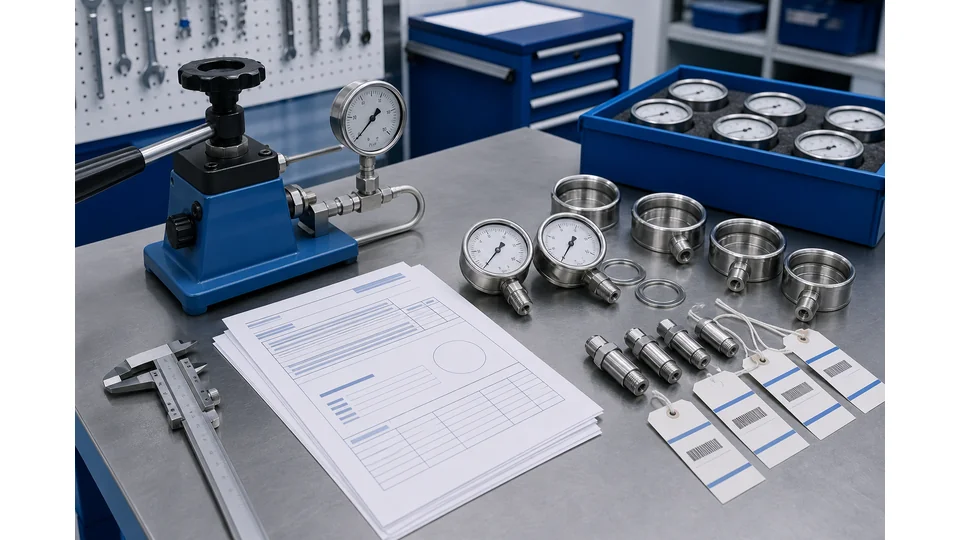
Writing “EN 837-1 compliant” is too broad by itself. A useful RFQ translates the standard into selected values that a factory, distributor and inspector can verify.
| RFQ item | Why it matters | What to confirm |
|---|---|---|
| Nominal size | EN-style gauges are commonly specified by millimeter dial size. | 40, 50, 63, 100, 160 or 250 mm; viewing distance; mounting position. |
| Pressure range | The range must cover normal pressure and credible abnormal pressure. | Operating pressure, maximum pressure, startup peaks, vacuum or compound range. |
| Accuracy class | Accuracy is tied to full scale and acceptance tolerance. | Class 0.6, 1.0, 1.6, 2.5 or project requirement; calibration certificate need. |
| Connection | Thread mismatch causes leakage and field rework. | G, BSP, NPT or metric thread; bottom or back connection; sealing surface. |
| Safety case | Gas, steam, oxygen and high pressure may need operator protection. | Open front, blow-out device, solid-front safety pattern and rear vent direction. |
Accuracy class, range selection and the 75 percent habit
Accuracy class is normally a percentage of full-scale span, not a percentage of the reading. A 0-10 bar gauge with class 1.6 has a different absolute tolerance from a 0-100 bar gauge with the same class. Oversizing a gauge “for safety” can make normal readings too coarse for process control.
A practical rule is to keep normal steady pressure in the readable middle portion of the dial and avoid continuous operation at the top of the scale. Many engineers target normal operation around 50-75% of full scale for steady service, with allowance for startup, pump shutoff head and pressure relief settings. Pulsating service, hydraulic spikes and compressor discharge lines may require a liquid-filled gauge, snubber, pressure limiter or transmitter.
For deeper background, compare this article with Manogauge’s pressure gauge accuracy class selection guide and pressure gauge snubber selection guide.
Request an EN 837-1 Gauge RFQ ReviewOur engineers respond within 24 hours→Safety patterns and what EN 837-1 cannot prove
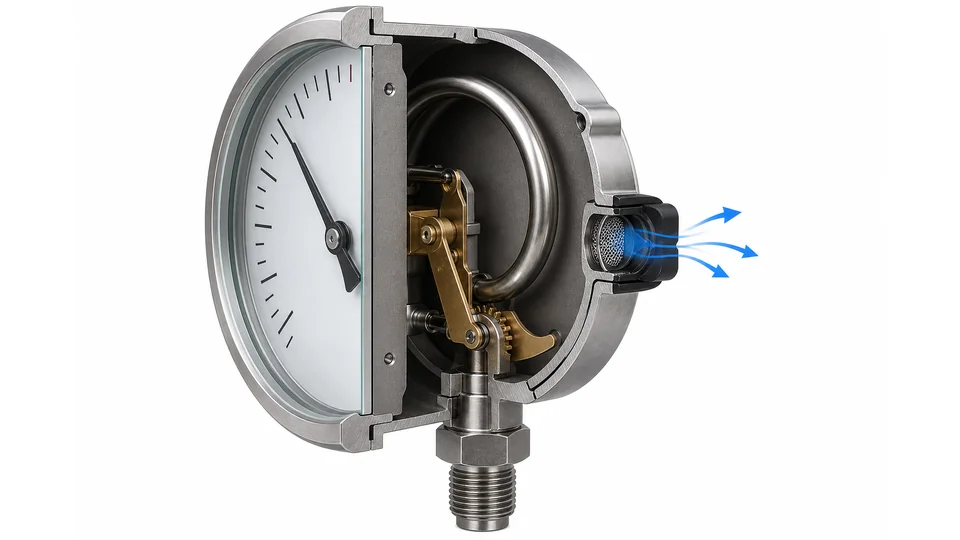
Safety pattern is one of the most misunderstood parts of EN-style pressure gauge selection. In higher-risk service, the question is not only whether the gauge reads correctly. It is also where energy and process fluid go if the Bourdon tube ruptures inside the case. Safety construction may include a blow-out device, a solid front baffle and a rear pressure relief path so failure energy is directed away from the operator.
This does not mean every application requires the highest safety pattern. Low-pressure water, compressed air panels, hydraulic test points, steam headers, oxygen service and corrosive chemical lines have different risks. The buyer must define medium, pressure, temperature, phase, toxicity, flammability, installation direction and operator exposure before selecting the case design.
EN 837-1 also cannot prove chemical compatibility, sanitary suitability, hazardous-area approval, oxygen cleanliness or a national certification unless those requirements are separately specified and documented.
EN 837-1 versus ASME B40.100 in global sourcing
EN 837-1 and ASME B40.100 are often both seen in international pressure gauge sourcing. They are not interchangeable purchase shortcuts. EN practice commonly uses metric nominal sizes, bar/MPa scales and G-type or metric connections, while ASME-oriented projects often use inch dial sizes, psi scales and NPT connections. Accuracy naming and accessory coverage can also differ.
For export orders, use the project region and equipment package to decide which reference standard belongs in the RFQ. A European skid may ask for EN 837-1 and CE/PED documentation. A North American package may prefer ASME B40.100 terms and NPT connections. A multinational OEM may need dual-scale dials, customer-specific marking, certificates of conformity and calibration reports.
Manogauge, based in Zhejiang, China, manufactures industrial pressure gauges under an ISO 9001 quality system and exports to multiple markets. Still, no article can replace a project specification: the final standard edition, acceptance criteria, certificates and inspection records must be confirmed before production.
Practical RFQ checklist before ordering EN 837-1 gauges
Before sending an RFQ, define the data that affects both safety and measurement quality. Do not rely on a product photo or a single line description.
- Medium, concentration, phase, temperature and cleaning chemicals.
- Operating pressure, maximum pressure, vacuum possibility and pulsation level.
- Required range, unit, dial diameter, accuracy class and viewing distance.
- Wetted material: brass, 304, 316L, Monel, Hastelloy or diaphragm seal where needed.
- Connection thread, mounting direction, sealing method and installation accessories.
- Case material, IP rating, liquid fill, blow-out protection and safety pattern.
- Certificate needs: conformity declaration, calibration certificate, material certificate or batch inspection record.
Used this way, the EN 837-1 pressure gauge standard becomes a clear engineering checklist instead of a vague compliance phrase. It helps buyers compare suppliers, reduce thread and range errors, and document why a selected gauge is suitable for the actual service.
Related products
- Stainless Steel Pressure Gauge - Radial (ZX-01-R) — 0–100 MPa
- General Pressure Gauge - Radial (ZX-08-R) — 0–40 MPa
Frequently asked questions
What is the EN 837-1 pressure gauge standard?
EN 837-1 is a European standard reference for Bourdon tube indicating pressure gauges, vacuum gauges and compound gauges. It covers dimensional, metrological, construction, testing and safety topics, but the purchase specification must still define the actual process conditions.
Does EN 837-1 compliance mean a gauge is safe for any medium?
No. EN 837-1 does not replace material compatibility, oxygen cleaning, sanitary design, hazardous-area approval or project-specific pressure and temperature checks. These must be specified separately.
How should I choose the pressure range under EN 837-1 practice?
Normal steady pressure is commonly kept in a readable middle portion of the dial, often around 50-75% of full scale, while startup peaks, shutoff pressure, pulsation and relief settings must also be considered.
What is the difference between EN 837-1 and ASME B40.100?
EN 837-1 is commonly used with metric nominal sizes, bar or MPa scales and European connection practice. ASME B40.100 is a North American reference covering pressure gauges and gauge attachments, often used with inch sizes, psi scales and NPT connections.
What should an RFQ include besides “EN 837-1 compliant”?
Include medium, pressure range, accuracy class, dial size, connection, wetted material, case material, liquid fill, safety pattern, IP rating, accessories, certificate needs and inspection records.