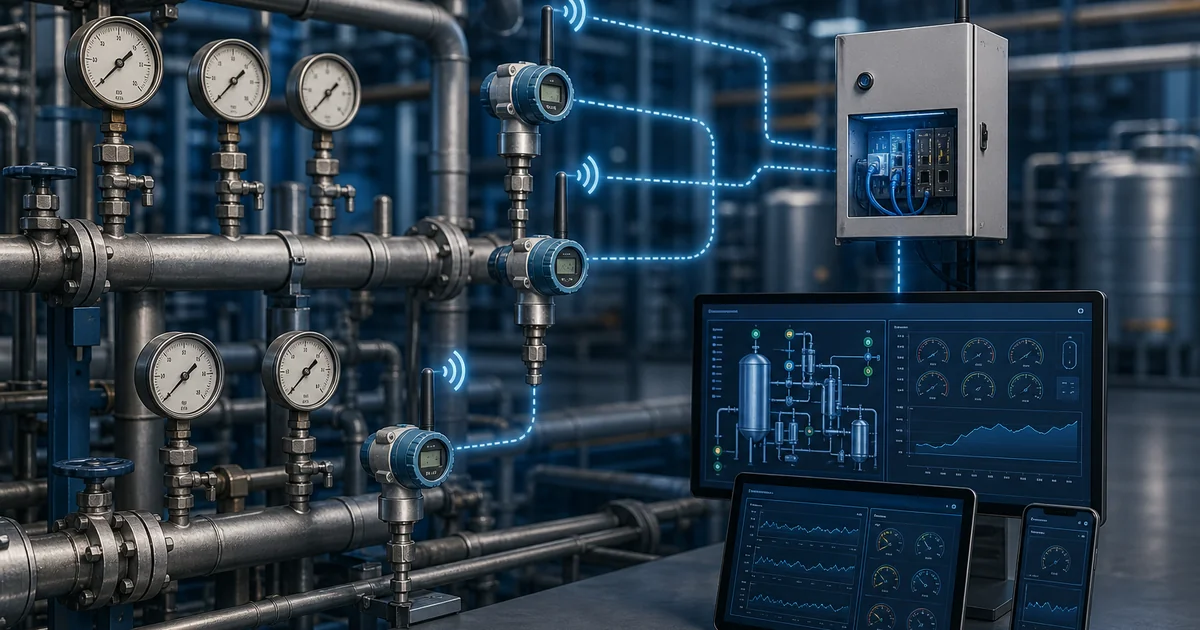
IIoT remote pressure monitoring is the practice of adding pressure transmitters, digital pressure gauges or wireless nodes to pressure points that were previously checked only by walking the plant. A retrofit can improve visibility for utilities, pumps, filters, compressed air, water treatment and process skids, but it must be specified from real pressure behavior rather than from a generic smart-factory promise.
What IIoT remote pressure monitoring actually changes
IIoT remote pressure monitoring changes how pressure readings are collected, trended and acted on. It does not change the physics of the pressure point. A Bourdon tube gauge still gives fast local confirmation. A pressure transmitter converts pressure into a signal for a PLC, gateway or cloud system. A wireless node can reduce cabling work on existing plants, but it introduces battery, radio, enclosure and cybersecurity questions.
The International Society of Automation notes that low-power wide-area industrial temperature and pressure sensors can improve maintenance understanding and decision making in remote monitoring applications. See the ISA article on temperature and pressure monitoring with IIoT sensors. For a plant engineer, the practical question is narrower: which existing gauge points deserve continuous data, and which should remain manual inspection points?
Review Digital Pressure Gauge OptionsExplore 143+ industrial gauge models→Start with pressure points, not with the dashboard
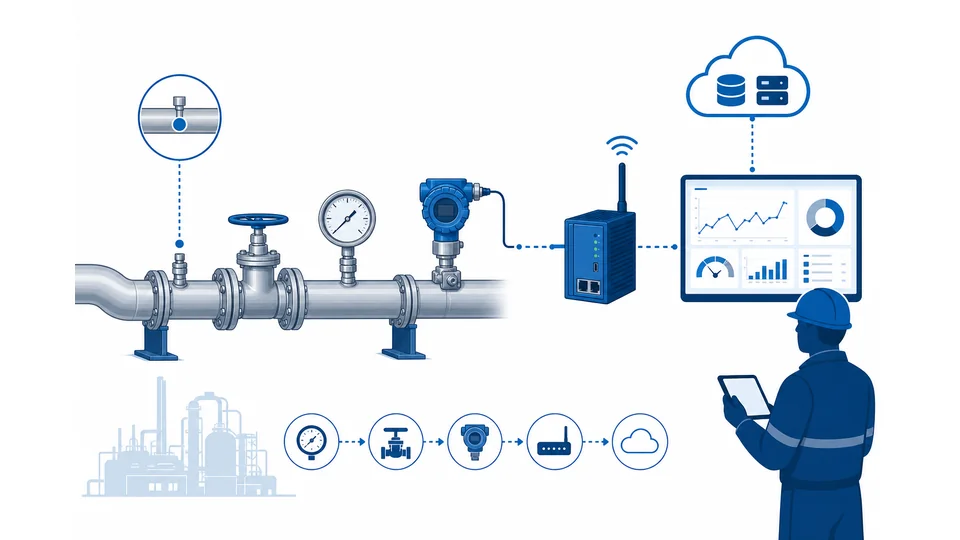
A useful retrofit begins with a pressure-point inventory. List the medium, normal pressure, maximum pressure, minimum useful pressure, temperature, pulsation, vibration, connection thread, isolation valve, maintenance access and current inspection route. Pumps, filters, compressed air headers, boiler feedwater, cooling loops, hydraulic units and water treatment skids often provide better first candidates than every gauge in the plant.
| Retrofit target | Signal value | Instrument approach |
|---|---|---|
| Pump discharge and suction | Low suction, blocked discharge, cavitation support, pump degradation trend | Local gauge plus transmitter where operators need remote alarm or trend |
| Filter inlet and outlet | Loading trend and changeout timing | Two transmitters or a differential pressure gauge/transmitter |
| Compressed air header | Pressure drop, leakage investigation, compressor control support | Digital gauge, transmitter or wireless node with appropriate range |
| Remote utility skid | Reduced manual rounds and faster abnormal-condition discovery | Wireless pressure transmitter when cabling is difficult and battery maintenance is acceptable |
Choose transmitters and digital gauges from the pressure behavior
A wireless pressure transmitter or digital pressure gauge should be selected from real pressure behavior. Confirm whether pressure is steady, pulsating, vacuum, compound, low differential, high static pressure, wet, corrosive, viscous or temperature-sensitive. Normal operating pressure should sit in a readable and accurate part of the selected range, with allowance for start-up, shutdown, cleaning, test pressure and occasional upset conditions.
Accuracy should match the decision. A utility trend may not need laboratory accuracy, while a custody, dosing or validated process point may require traceable calibration and tighter uncertainty. If the existing gauge has a snubber, siphon, diaphragm seal, capillary or remote mount, do not remove that protection just because the new device has electronics. The same pulsation, temperature, clogging and corrosion risks still exist.
Request an IIoT Pressure Retrofit RFQ ChecklistOur engineers respond within 24 hours→Keep local indication where operators still need it
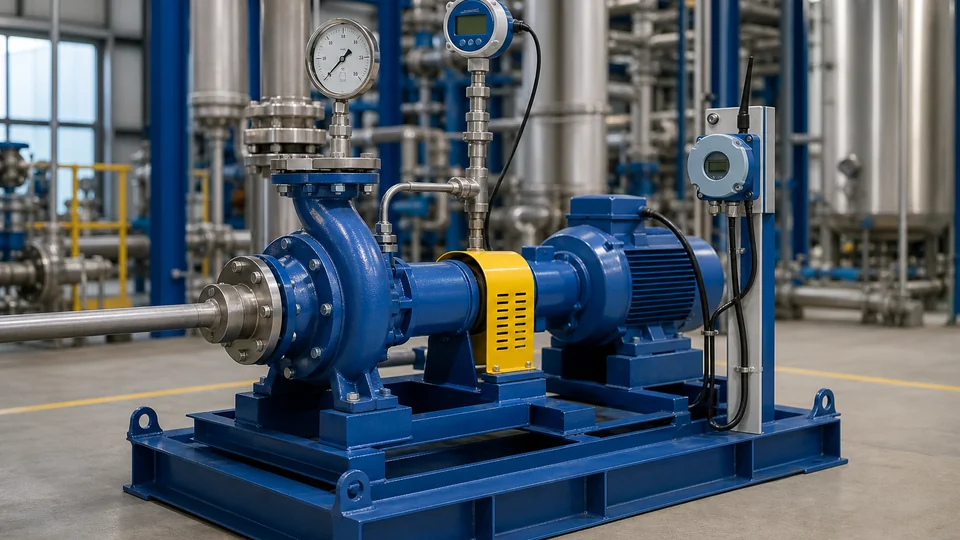
Many retrofits fail when the project replaces all visible gauges with remote data and then discovers that operators, mechanics and commissioning teams still need a face-level reading at the equipment. A local gauge supports lockout checks, pump start-up, valve troubleshooting and fast comparison with the control room. A transmitter supports alarm logic, trends and records. The two roles are different.
For brownfield sites, consider a tee arrangement, a gauge-transmitter combination, a digital pressure gauge with local display, or a manifold that allows safe isolation and replacement. The installation should avoid dead legs where solids collect, long unsupported nipples that vibrate, thread mismatches and locations where the device is hidden behind hot surfaces or moving equipment.
Limits: pressure data is not predictive maintenance by itself
Predictive maintenance pressure monitoring is strongest when pressure data is interpreted with flow, temperature, current, vibration, valve state and maintenance history. A falling discharge pressure may suggest pump wear, a blocked strainer, a control valve change or a tank-level issue. A filter differential pressure trend can support changeout timing, but it does not identify every water-quality or membrane-fouling mechanism by itself.
Pressure data also cannot prove safe operation in hazardous areas, sanitary systems or high-pressure processes. Explosion protection, food-contact suitability, cleaning chemistry, overpressure protection, SIL or functional safety claims, and cybersecurity controls must be confirmed by qualified engineers and the project specification. Treat remote monitoring as a visibility layer, not as permission to ignore mechanical design limits.
RFQ checklist for an IIoT pressure monitoring retrofit
An RFQ should include the medium, pressure range, proof pressure, process temperature, ambient temperature, wetted material, seal material, thread or flange connection, accuracy, output signal, wireless protocol if required, power supply, battery-life expectation, enclosure rating, cable entry, hazardous-area requirement, calibration certificate, display requirement, sampling interval and alarm threshold.
Useful internal references include pressure transmitter vs pressure gauge selection, pressure gauge snubber selection for pulsation and digital pressure gauge options for local indication. A practical IIoT remote pressure monitoring project starts small, validates the signal against field readings, and then expands only to pressure points where the data changes a maintenance or operating decision.
Key takeaways
- Start with pressure-point inventory, not dashboard design.
- Keep local gauges where operators need field confirmation.
- Select transmitters from real pressure behavior, medium, range, vibration and temperature.
- Pressure trends support maintenance decisions but do not prove safety or process compliance by themselves.
Frequently asked questions
What is IIoT remote pressure monitoring?
It is the use of pressure transmitters, digital gauges, wireless nodes and gateways to collect pressure readings remotely from equipment that may still keep local gauges for field confirmation.
Should every mechanical pressure gauge be replaced during an IIoT retrofit?
No. Many plants keep local gauges for commissioning, lockout checks and troubleshooting, then add transmitters only to points where trends or alarms change maintenance decisions.
Which pressure points are good retrofit candidates?
Pump suction and discharge, filter inlet and outlet, compressed air headers, cooling loops, water treatment skids and remote utility packages are common candidates when pressure trends support action.
Can pressure monitoring predict equipment failure by itself?
No. Pressure trends are useful, but they should be interpreted with flow, temperature, current, vibration, valve state, process state and maintenance history.
What should be confirmed before ordering wireless pressure transmitters?
Confirm medium, range, connection, wetted material, temperature, vibration, enclosure rating, hazardous-area need, wireless protocol, battery maintenance, sampling interval and alarm thresholds.